Briefing
On the evening of the thirteenth of March 1997, hundreds of people across Arizona
telephoned police departments, newsrooms and air force bases to report lights in
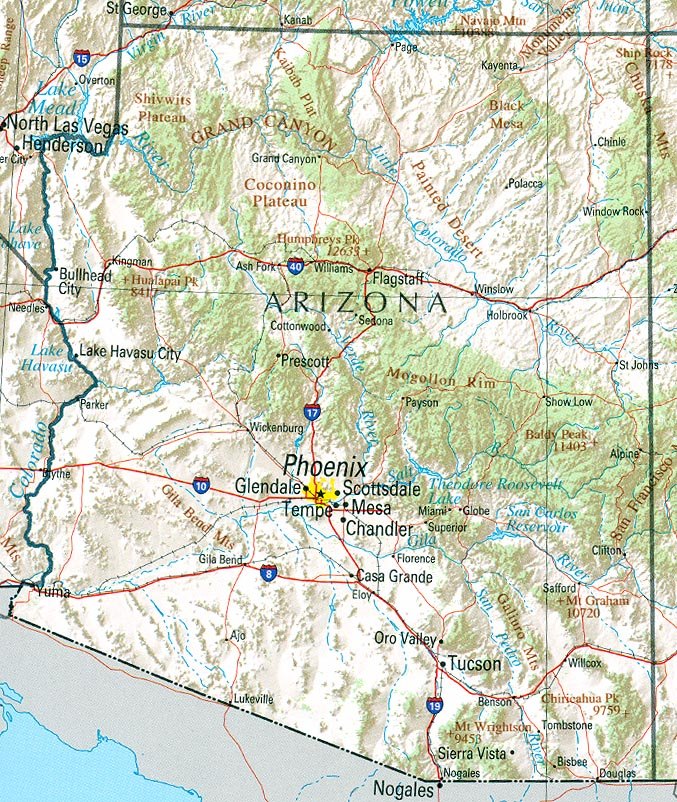
the sky. Calls came in from Kingman in the north-west and from Tucson in the
south [1]. It became, and remains, one of the most widely reported aerial
incidents in the United States.
The thing to understand before anything else is that there were at least two
separate events that night, about two hours apart, and they did not behave the
same way. The first was a group of lights in a V or boomerang arrangement that
moved steadily from north to south down the state. The second, around two hours
later, was a row of lights that hung more or less still in the south-western sky
over Phoenix and then went out. Both events were filmed. The ten o’clock
footage is the one almost everyone has seen, and when people say “the Phoenix
Lights video” they mean that one — but videotape of the earlier formation exists
too, and shows seven lights and the V-shape clearly [2].
Almost every retelling merges the two, and that is why the case feels
simultaneously explained and unexplained. It is both — of different events. The
official explanation, when it finally arrived four months later, was an
explanation of the second one.
This is not our reading of the case. It is stated plainly and independently by
sources on opposite sides of it: by the journalist who set out to debunk the
whole thing [2], and by a physicist arguing that it was not explained at all [3].
When the two sides agree about the structure of the night and disagree only about
the cause, the structure is not an interpretation. It is the record.
Sequence of events
The first event, about 20:15 to 20:45
Lights in a V or boomerang arrangement moved down the state. The best timings in
the contemporaneous record place the group north of Prescott at about 8.15 and
south of Tucson by about 8.45 — “200 miles in 30 minutes, which suggests an air
speed of 400 miles per hour” [2].
How many lights there were was never agreed: five, six or seven, depending on the
witness. Videotape of this phase “show[s] seven lights, and the V-shape, clearly”
[2].
Two of the witnesses were reporters at the Phoenix New Times, out separately
that evening, and what they saw is the honest centre of this case. “Each saw a
V-shape of five lights moving slowly from north to south. The lights were bright
and yellow-white, and seemed very high in the sky. No sound accompanied them.”
And then they disagreed with each other about the only question that matters:
“Holthouse says he perceived that something connected the lights in a boomerang
shape; Kiefer disagrees, saying they didn’t seem connected” [2].
Two trained observers, the same paper, the same night, opposite conclusions on
whether there was a solid object there at all. Any account of this case that
sounds certain about that point is more certain than its own witnesses were.
Four months of denial
For sixteen weeks, nothing. “Military officials have said they had nothing in the
air over Phoenix and dismissed the reports” [1]. The Air Force’s immediate
response to press enquiries at Luke Air Force Base in Phoenix and Davis-Monthan
near Tucson was that it had no flare-related operations at the time [3]. On 26
June, three and a half months after the event, the New Times reported that it
“has contacted numerous military bases in the Southwest, but none claims the
planes” [2].
The second event, about 22:00
A row of lights appeared one after another in the sky south of Phoenix, hung
there, and was filmed by a number of residents [3]. This is the Phoenix Lights
of popular memory.
The explanation, 25 July 1997
The account arrived on a Friday in late July, and it came out sideways. Capt.
Eileen Bienz of the Arizona Air National Guard told the Arizona Republic that
she had conducted her own investigation after receiving “one too many calls” [1].
It was produced by a press officer’s own digging, not released by the unit
involved.
What she had found, confirmed by Capt. Drew Sullins of the Maryland Air National
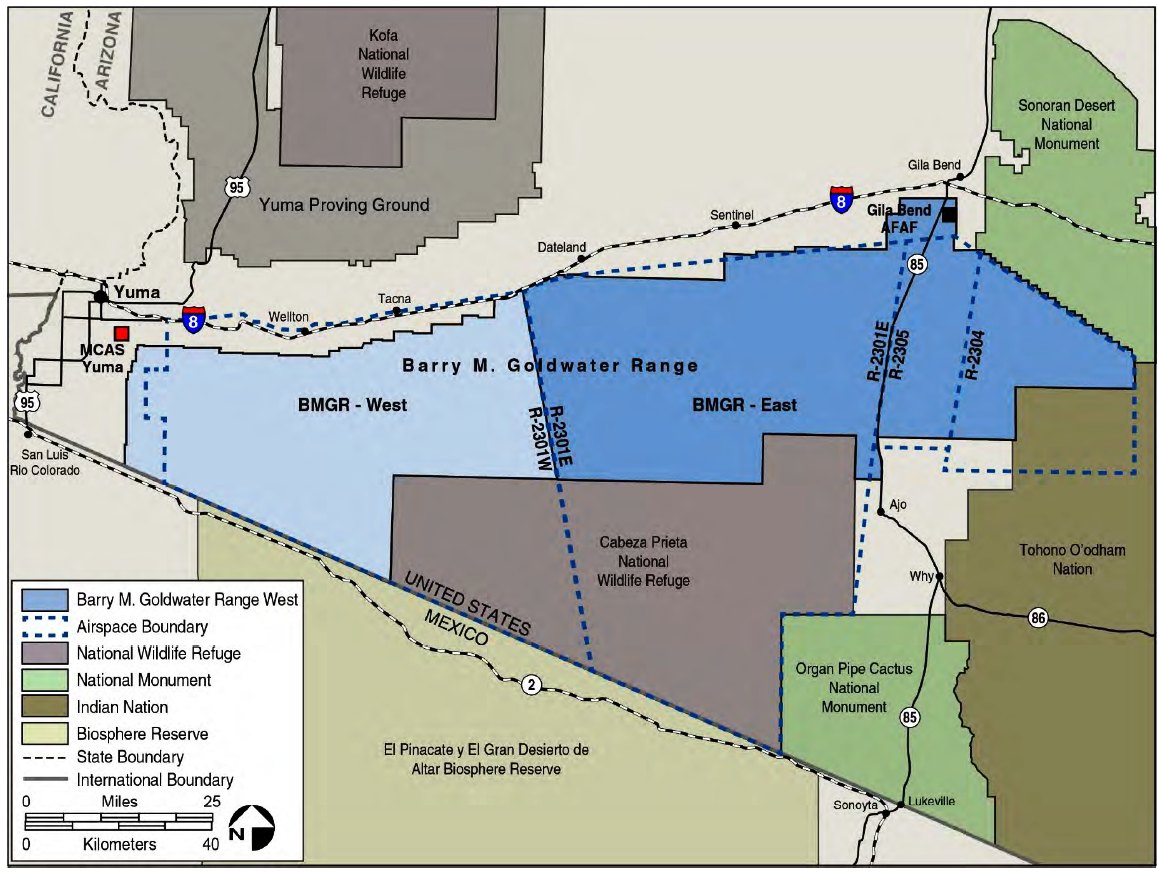
Guard, was that eight A-10 ground-attack aircraft had been operating on the Barry
M. Goldwater Range, “a busy desert bombing area 60 miles south-southwest of
Phoenix where the military routinely conducts night training.” They were dropping
“high-intensity flares from 15,000 feet to illuminate the target area… The flares
fall slowly by parachute and illuminate a wide area” [1]. Maccabee independently
gives the same altitude [3].
Then the detail that does the work: “Before returning to Davis-Monthan Air Force
Base in Tucson that night, the planes jettisoned all their remaining flares at
high altitude, which would have created what one pilot called ‘one hell of a
light show,’ Sullins said” [1].
The aircraft were in Arizona under Operation Snowbird, the programme that
brings units from northern bases south for winter training between November and
April [1]. (Not to be confused with the Canadian Forces Snowbirds display team,
which was also proposed in 1997 and ruled out: their season “does not begin until
April” and the team “was not in Arizona in March” [2].)
And in the same article that carried the explanation, on the day it appeared:
“That wouldn’t appear to cover all the sightings reported that night, as many came
from far north of Phoenix, but the flares were dropping in the general direction
of lights captured in a videotape” [1].
The limit of the official explanation was printed alongside the official
explanation. Nobody has had to argue the point since; it was conceded at birth.
Documentary record
What the radar did not show, and why that proves nothing
This is the strongest technical material in the case, and it is almost always
used backwards.
Bill Grava was on duty as an air traffic controller at Sky Harbor International
Airport on the night of 13 March. He saw the lights himself, low on the southern
horizon behind South Mountain, and “the lights were so bright that he thought
they might have been flares.” He confirmed that nothing registered on radar as
the objects passed overhead, and Captain Stacey Cotton of Luke Air Force Base
confirmed it too [2].
Cotton then explained it. The radar used by air traffic controllers reads signals
emitted by transponders in the aircraft themselves. In a formation of seven
aircraft, normally only the lead aircraft would have its transponder switched on.
With that one transponder off, the formation could pass without detection — and
Grava added that depending on altitude, that may have been perfectly legal [2].
The absence of a radar return is therefore not evidence of anything. It is
exactly what an unsquawking formation of ordinary aircraft would produce. We
state this plainly because the opposite is asserted constantly, and because the
two men who would know both said so, on the record, in 1997.
The man with the telescope
Mitch Stanley was twenty-one and had a ten-inch reflecting telescope in his back
garden, with about sixty times the resolving power of his naked eye. He put it on
the moving formation. The leading three lights fitted his field of view.
“What looked like individual lights to the naked eye actually split into two
under the resolving power of the telescope. The lights were located on the
undersides of squarish wings.” Asked about it afterwards: “They were just planes,
I didn’t want to look at them.” And: “They were planes. There’s no way I could
have mistaken that” [2].
Two things must be kept straight about this. First, Stanley was looking at the
first event, the moving V — not at the ten o’clock lights. Second, this is a
single observer with a good instrument and no record of what he saw, and it is in
flat contradiction to a great many people who were sure they saw one solid shape.
We report both, and neither settles the other.
There is a coda to it that we include because leaving it out would make the case
tidier than it is. Frances Barwood, the Phoenix city councilwoman pressing for an
investigation, was told about Stanley’s observation and did not pursue it,
passing it to a private laboratory instead. Stanley’s mother’s assessment: “They
really don’t want to know” [2].
What was asked, and who answered
Barwood called for a city investigation [2] and pushed for an Air Force one [1].
Of the flare explanation she said: “If that is their explanation then they need to
do a re-enactment so people can say that’s what they saw or not what they saw”
[1]. She wrote to Senator John McCain urging an Air Force investigation; McCain
forwarded the letter to the Air Force, which replied that it no longer
investigates UFO reports [1].
That reply is accurate and is not a dodge. Project Blue Book closed in 1969. By
1997 there was no office to send the letter to. The absence of an investigation in
this case is a fact about an institution’s remit, not about a cover-up — and that
distinction is one the case has rarely been allowed.
The governor
Fife Symington III was governor of Arizona on the night. In 1997 he called a press
conference at which his chief of staff appeared in an alien costume.
Ten years later, on 9 November 2007, he published a commentary under his own
byline on CNN. It is not an interview and not a paraphrase; he wrote it, and CNN
labelled it as his opinion [4].
“I witnessed a massive delta-shaped, craft silently navigate over Squaw Peak, a
mountain range in Phoenix, Arizona… As a pilot and a former Air Force Officer, I
can definitively say that this craft did not resemble any man-made object I’d
ever seen. And it was certainly not high-altitude flares because flares don’t fly
in formation.”
On the press conference: “I decided to lighten the mood of the state by calling a
press conference… We managed to lessen the sense of panic but, at the same time,
upset many of my constituents.” And: “I would now like to set the record straight.
I never meant to ridicule anyone” [4].
Three notes of care. Symington places his own sighting over Squaw Peak — renamed
Piestewa Peak in 2003 — while turning west to look for the distant lights, which
is a description of the first event, not the ten o’clock row.
That matters for the line of his that is quoted most often. “It was certainly not
high-altitude flares because flares don’t fly in formation” reads as a refutation
of the Air Force, and it is not one, because the flare account was never an
account of the event he is describing. The two are talking past each other — which
is the central confusion of this case appearing in its most senior witness.
And his account is a recollection published a decade afterwards, by a man who
had by then become a public advocate on the subject. It is first-hand testimony
from a named, accountable person who held office on the night. It is not
contemporaneous, and we do not present it as though it were.
Open questions
Could the flares account for what was filmed? This remains genuinely open, and
we are not going to close it by assertion in either direction. Witnesses objected
that the lights were too bright to be fifty miles away, that they could see no
parachutes and no smoke plumes, and that they neither saw nor heard any aircraft
that could have dropped them [3]. Maccabee — a physicist who wanted this answered
— put the question and left it open: “If the lights were flares over the Goldwater
Range more than 50 miles from Phoenix, why were they so bright? Why did the
arrangements seem so geometric, and why didn’t they drop downward?” [3] No traced
calculation settles it.
Cutting the other way, and included for the same reason: Motzer observed that
there were comparatively few reports of the ten o’clock event, and that most came
from people living at altitude above the city, who could see over the mountains
better than residents on the valley floor [3]. That is precisely what a distant
source behind a ridge would produce.
Where were the ten o’clock lights? Richard Motzer, MUFON’s Arizona field
investigator, triangulated sight-lines from six witnesses and concluded the
lights were a few miles south of the Sierra Estrella. The Goldwater Range lies
from about fifty to well over a hundred miles out. Maccabee states the
consequence baldly: either the Guard dropped its flares roughly thirty miles
north-east of the range, or Motzer’s triangulation was wrong [3]. It is a
specific, falsifiable disagreement between two people who both wanted an answer,
and it has never been resolved.
How many events were there? We say at least two because two is what the
sources on both sides describe. But Bill Hamilton’s MUFON report of May 1997
counted four: lights at about eight o’clock, a moving triangular object, the ten
o’clock array south of Phoenix, and two orange lights near Luke Air Force Base
between eight and ten [3]. Our two-event framing is a simplification of a messier
record, and we would rather say so than present it as the settled taxonomy.
What was the first event? There is no document. What exists is journalistic
inference: “Pilots consulted by New Times say that a group of planes flying in
formation at night suggests military aircraft. The squarish wings, as opposed to
the swept, triangular variety, suggest A-10s or T-37 fighter-trainers” [2]. That
is a reasonable inference by qualified people reasoning from Stanley’s
description. It is not a finding, no unit has ever claimed the flight, and the
eight Maryland A-10s are attached in the record to the Goldwater flare drop, not
to a transit down the state two hours earlier.
A pattern worth naming. The published detail in this case has become more
specific over time while its sourcing has become weaker. The 1997 reporting says
“high-intensity flares”; present-day accounts routinely specify LUU-2B/B flares
over a “North TAC range,” dropped by a named lieutenant colonel — none of which
appears in any contemporaneous source we traced, and the accounts naming that
officer contradict each other and the 1997 wire about how many aircraft were
involved. Precision that arrives twenty years late, without a document, is not
precision. We have removed all three from this file; see Corrections.
And one more event, which is not this one. A comparable flap occurred over
Phoenix on 14 January 1998 — it is the actual subject of [3]. The pattern
recurred. Material from 1998 is regularly absorbed into the 1997 story without
anyone saying so.
Status
The tier label on this file is a publication tier, not a claim about reliability.
OFFICIAL is our standard public case file carrying editorial analysis. It says
nothing about how true the contents are; that is what the text and the citations
are for.
What is settled: a great many people across Arizona reported lights on the
evening of 13 March 1997. The Air Force denied having anything in the air, and
four months later said that eight A-10s had jettisoned high-intensity
illumination flares over a gunnery range south-south-west of the city. Air
traffic control radar recorded nothing, for a reason that was explained at the
time and is not mysterious. One observer put a telescope on the earlier formation
and reported aircraft.
What is not settled: what the earlier formation was, whether the flare account
can carry the brightness and geometry of what was filmed, and where the ten
o’clock lights actually hung. The governor who presided over the night, and who
mocked it publicly at the time, said ten years later that he had seen something
he could not explain.
Outstanding: no primary military document about 13 March 1997 has ever been
produced — no sortie record, no range schedule, no munitions expenditure log. The
flare account rests entirely on two Air National Guard officers speaking to
reporters four months afterwards. That may well be all there is. It has never
been tested, because the only body that could have tested it had closed its file
drawer twenty-eight years earlier.
Corrections
10 November 2026. This file was rewritten against four contemporaneous and
first-hand sources, each read in full. The earlier version carried several
statements that we could not support, and per our corrections
policy we record what changed rather than quietly replacing it.
- The flares were described as “LUU-2B/B illumination flares.” That model number
appears in no contemporaneous source we traced. The 1997 reporting says
“high-intensity flares.” We have reverted to the sourced wording.
- The aircraft were attributed to the “104th Fighter Squadron.” No squadron
number appears in the 1997 record, which names the Maryland Air National Guard
and two officers. The squadron number has been removed.
- The earlier version placed the flare drop over “the Davis-Monthan and Barry M.
Goldwater training ranges.” Davis-Monthan is an air force base, not a range; it
is where the aircraft returned to. The flares were dropped on the Goldwater
Range.
- “Thousands of witnesses” has been changed to hundreds of reports, which is what
the contemporaneous sources support. The larger figure is now attributed to
Symington, who estimated “hundreds — if not thousands.”
- The claim that Frances Barwood “recorded statements from more than 700
witnesses” has been removed. We could not trace it to any source. What is on
the 1997 record is her call for a city investigation, her demand for a
re-enactment, and her letter to Senator McCain.
- “No radar data has been publicly released for either phase” was wrong and
materially misleading. The controller on duty and a captain at Luke Air Force
Base both went on the record in 1997, and the second of them explained why
transponder-based radar would not see such a formation. That explanation is now
in the file, and the old framing — absence of radar as a mystery — has been
removed.
- The timings have been corrected from “approximately 19:30 and 20:30” to the
sourced 20:15 north of Prescott and 20:45 south of Tucson.
- Symington’s account was described as “delivered in interviews and a formal
public declaration.” It was a commentary published under his own byline by CNN
on 9 November 2007, and is now cited and quoted as such.
- The claim that the earliest reports came from Henderson, Nevada has been
removed. It is widely repeated; it is not in any of the four sources this file
now rests on.
- The previous Status section treated the OFFICIAL tier as an evidential
judgement — a file “admitted at the OFFICIAL tier on the strength of three
convergent disclosures.” The tier is a publication tier and carries no claim
about reliability. That section has been rewritten.
- Mitch Stanley’s telescope observation, the disagreement between the two New
Times reporters, Motzer’s triangulation, Hamilton’s four-event count and the
four months of military denial were absent from the earlier version. All are in
the sources, and all of them matter.
References
- “Military now says flares may be cause of mysterious Arizona lights,” Las Vegas Sun, Friday 25 July 1997. Wire report, no byline. The first appearance of the flare explanation, quoting Capt. Drew Sullins (Maryland Air National Guard) and Capt. Eileen Bienz (Arizona Air National Guard). The live page now returns HTTP 410; linked to the Internet Archive capture of 3 November 2025.
- Tony Ortega, “The Great UFO Cover-up,” Phoenix New Times, 26 June 1997. Contemporaneous investigation and the single most useful document in the case. This is the debunking article and its tone is hostile to the witnesses — Maccabee calls it “a mockery” of them [3]. We cite it for its reporting, which is first-hand and detailed, not for its tone. The live page returns HTTP 403; linked to the capture of 14 October 2026.
- Bruce Maccabee, “Phoenix lights revisited,” MUFON UFO Journal, February 1999, p. 3. Photo analysis by a physicist at the Naval Surface Weapons Center who argues the case is unexplained — partisan in the opposite direction to [2], which is why the two agreeing on the shape of the night matters. Chiefly concerns the 14 January 1998 recurrence, but carries the fullest account of the 1997 dispute, Hamilton’s four-event count, Motzer’s triangulation and the Air Force’s initial denial. Read from a scan; text recovered by optical character recognition. We have not located a stable public URL for this issue and do not link to one rather than link to a guess.
- Fife Symington, “Symington: I saw a UFO in the Arizona sky,” CNN, 9 November 2007. Bylined “By Fife Symington, Special to CNN” and labelled by CNN as commentary: “The opinions expressed in this commentary are solely those of the writer.” Published three days before the National Press Club event he moderated on 12 November 2007. The live page returns HTTP 451 in this region; linked to the capture of 5 May 2026.